Chimney Repairs and Repointing in Derby: What's Involved
Call: 01332-529704
Crumbling mortar on a chimney stack is one of the most common problems we see on Derby properties. We carry out chimney repairs and repointing across Derby and Derbyshire — from a first inspection to a full scaffolded repoint, flaunching repair, lead flashing replacement, and brick work.
- Free, photographed chimney inspection with a written quote before any scaffold goes up
- IPAF certified for powered access and PASMA certified for mobile scaffold towers, so the right access method is used on every job
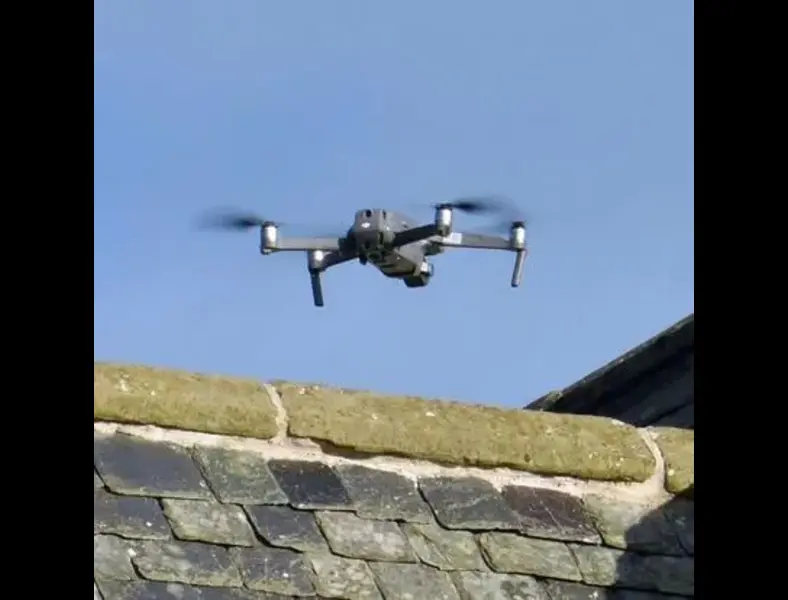
- Drone survey available for a close-up look at the stack before quoting, with no scaffold needed just to assess the problem
What Are the Signs Your Derby Chimney Needs Repointing?
We carry out chimney repairs and repointing across Derby and Derbyshire. Our team handles everything from a first inspection to a full scaffolded repoint, flaunching repair, lead flashing replacement, and brick work. You get a written quote before any work starts and a local team who knows Derby’s housing stock.
Most chimney problems are visible before they become serious. A pair of binoculars from the pavement is often enough to spot the early signs on Derby’s tall red-brick stacks.
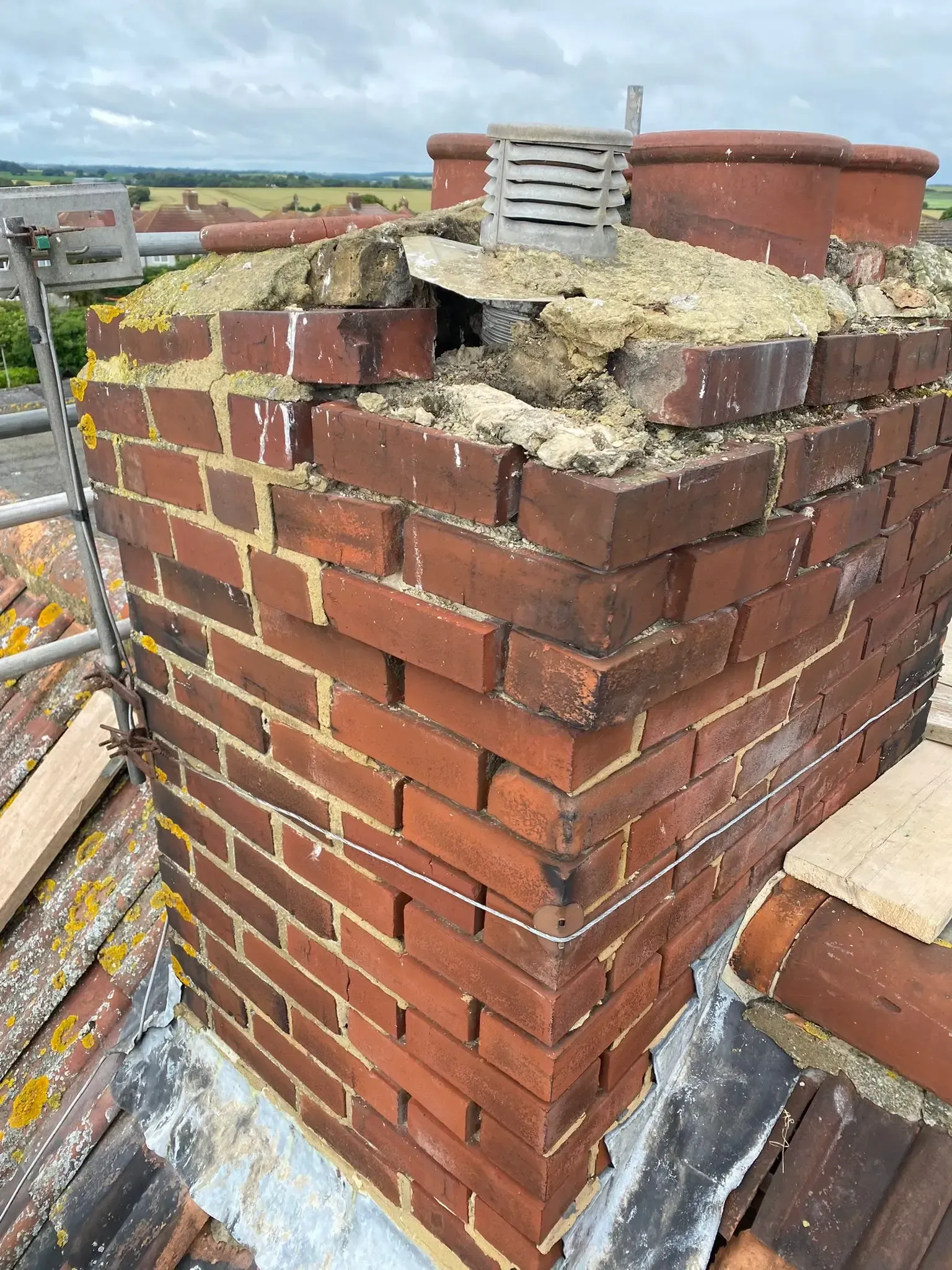
- Mortar that looks soft, powdery, or has receded back from the brick face
- White staining on the brickwork — this is efflorescence, caused by water moving through the joints
- Damp patches on the chimney breast wall inside, particularly after rain
- Brick faces starting to flake away — this is frost spalling, common on Derby stacks after cold winters
- Mortar dust or small pieces of brick falling into the fireplace
- A chimney pot that looks loose or sits at an angle
- A stack that appears to lean or has visible cracks running through the brickwork
In areas like Normanton, Pear Tree, and Spondon, where Victorian terraces with tall red-brick stacks are common, we see these signs regularly after a wet Derby autumn. The pattern is nearly always the same — open joints let water in, Derby frosts expand it, and the bricks start to break apart from the inside.
If you spot any of these signs, do not leave it until spring. The damage compounds through every freeze-thaw cycle.
What Does Chimney Repointing Actually Involve?
Chimney repointing is the process of removing failed mortar from the joints between chimney bricks and replacing it with fresh mortar. It restores the structural strength of the stack and stops water getting in.
Here is what we do on every chimney repoint in Derby:
- Scaffold erected — a safe working platform is set up around all four faces of the stack
- Full inspection — joints, bricks, flaunching, lead flashing, and chimney pot condition all checked and photographed
- Old mortar raked out — cut back to a minimum depth using a plugging chisel; no angle grinders on older brickwork
- Joints cleaned — dust brushed out and bricks dampened so they do not pull moisture from the fresh mortar
- Correct mortar mixed — natural hydraulic lime for pre-1920 Derby stacks; sand and cement for post-war builds; colour matched to existing
- Joints filled and finished — mortar pressed firmly in and tooled to a profile that sheds water away from the brick face
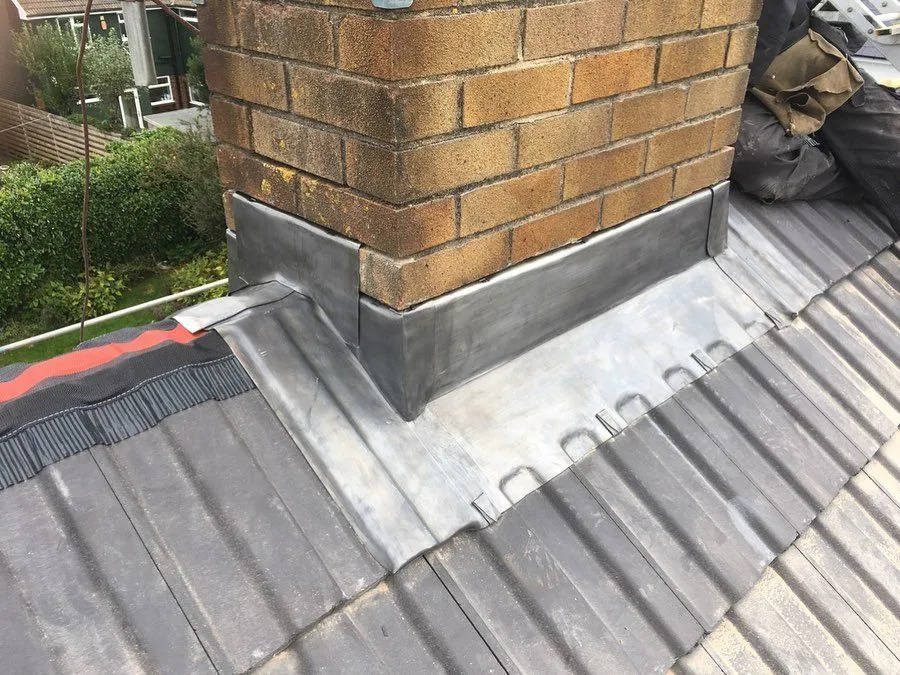
- Flaunching and lead flashing checked — repaired or replaced where needed
- Scaffold removed and site cleared — final ground-level check before we leave
A well-executed repoint on a Derby chimney, using the right mortar, should give many years of protection before the joints need attention again.
The Difference Between Chimney Pointing and Repointing
These two terms are often used interchangeably, but they describe slightly different scopes of work. Pointing refers to the mortar joints as they originally were when the chimney was built. Repointing is the process of raking out those joints and renewing them. On any chimney that has been standing for more than a few decades, what you need is a repoint — the original pointing has to come out before the new mortar can bond correctly.
A surface skim over existing joints is not repointing. It will not last and it can trap moisture behind it, making things worse. We rake out to the correct depth every time.
How Much Does Chimney Repointing Cost in Derby?
The cost of chimney repointing in Derby varies depending on the size of the stack, how many faces need repointing, the access required, and the condition of the bricks and flaunching.
As a general guide for Derby properties:
- Localised repoint on one or two faces: typically from around £300–£500
- Full stack repoint: typically from around £500–£900
- Flaunching repair added at the same time: usually a modest additional cost when scaffold is already in place
- Lead flashing repair or replacement: depends on the length and condition
The majority of the cost on any chimney job is safe access — scaffold hire and two qualified operatives working at height. Work quoted cheaply from a ladder is not a repoint that will last. If other maintenance is due — fascias, soffits, guttering, or ridge tile repairs — it makes financial sense to bundle it while the scaffold is already standing. We provide a full written quote after every inspection, with no hidden additions once the scaffold goes up.
How Often Does a Derby Chimney Need Repointing?
There is no fixed rule, but a chimney in good condition, repointed with the right mortar, should not need doing again for many years. Derby’s climate works against chimneys harder than many parts of the UK. Wet autumns, cold winters, and repeated freeze-thaw cycles through the season accelerate mortar wear — particularly on exposed north and west-facing stacks. Properties in areas like Allestree, Mickleover, and Breadsall, where stacks are often fully exposed to prevailing westerly weather, can show wear sooner than sheltered urban stacks.
A quick visual check each spring — after winter has done its worst — is the most practical maintenance habit. Homes with active log burners or open fires have an additional factor to watch: sulphur from burning solid fuel attacks mortar from inside the flue as well as from outside. Annual chimney sweeping helps reduce this, but it is worth including the external stack in any annual check.
Do You Need Scaffolding for Chimney Repointing in Derby?
For any chimney above single-storey height, proper scaffolding or an equivalent access platform is required. This is a legal requirement for working at height, and it also makes the difference between a repoint that lasts and one that does not.
A repoint carried out from a ladder cannot cover all four faces of the stack safely or thoroughly. Mortar application at an angle, under time pressure, does not produce joints that shed water correctly.
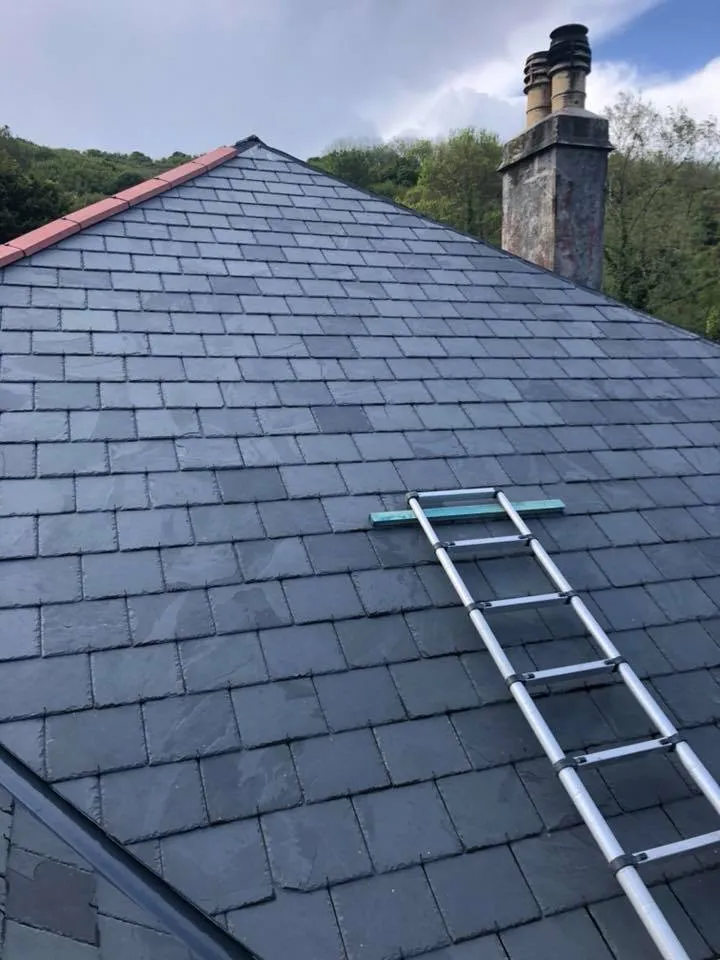
In parts of Derby such as Normanton and Pear Tree, narrow Victorian streets sometimes require a temporary traffic management permit for scaffold that overhangs the pavement. We handle the permit application and coordination with Derby City Council — you do not need to chase this yourself. Where a cherry picker or modular access tower is more practical than full tube-and-fitting scaffold, we will say so; the access method is confirmed in your written quote before work starts.
Can You Repoint a Chimney Yourself — or Do You Need a Professional?
For most Derby homeowners, chimney repointing is not a practical DIY job. Working at chimney height without a proper scaffold is dangerous. Using the wrong mortar — particularly hard cement on older Victorian brickwork — causes more damage than the failed mortar it replaces.
A large part of Derby’s housing stock is pre-1920 red brick, built with soft lime mortar that allows the brickwork to move slightly with temperature changes. Hard cement mix is stronger than the brick itself: when the stack expands in summer and contracts in winter frost, the brick cracks rather than the joint. We regularly carry out repairs on stacks where a previous contractor applied hard cement to Victorian brickwork — the repair cost is always higher than the original repoint would have been. If your chimney is on a listed building or in a Derby conservation area, the mortar specification and finish are not optional; we advise on this as part of every inspection at no charge.
Best Time of Year to Repoint a Chimney in Derbyshire
Late summer through to mid-October is the best window for chimney repointing in Derbyshire. Mortar needs sustained temperatures above 5°C to cure correctly, and Derbyshire’s first hard frosts often arrive in October — earlier than many homeowners expect.
We do carry out chimney repointing in winter — but only in mild spells where temperatures are reliably above 5°C and no frost is forecast within the curing period. Spring is also a good window if your stack came through winter with visible damage.
Do You Need Planning Permission for Chimney Repairs in Derby?
In most cases, no. Standard chimney repairs — repointing, flaunching repair, lead flashing replacement, and like-for-like work — fall under permitted development rights in Derby. There are two exceptions: if your property is Grade I or Grade II listed, any repair work that alters the character or appearance of the chimney requires Listed Building Consent. Derby also has several conservation areas, including parts of the city centre, Darley Abbey, and Mickleover, where external changes to chimneys may require consent. For like-for-like repairs using matching materials, consent is usually not required, but it is worth confirming with Derby City Council before work begins if you are unsure. We handle these questions as part of our standard survey process.
What Happens If You Ignore Damaged Chimney Mortar?
Failing chimney mortar does not stay the same from one year to the next — it gets worse, and the repair gets more expensive. Open joints let water into the brickwork, and in Derby’s winters that water freezes, expands, and forces the brick faces apart. Once bricks are spalling, a simple repoint becomes a repoint plus brick replacement, and if the structural integrity of the stack is compromised, you are looking at a partial or full rebuild. A stack with failing mortar and loose bricks is also a falling hazard — a leaning stack or visible cracks should be treated as urgent, not something to keep an eye on.
Chimney Repairs We Carry Out in Derby
We handle the full range of chimney repair work across Derby and Derbyshire. Our team carries out:
- Chimney repointing — full stack and localised, using the correct mortar for your brickwork type
- Flaunching repair and replacement — the mortar bed that holds your chimney pots in place and sheds water off the stack top
- Lead flashing repair and replacement — the seal between chimney and roof tiles
- Brick replacement — individual cracked or spalled bricks, matched as closely as possible to the original
- Partial chimney rebuild — where structural damage goes beyond what repointing can fix
- Full chimney removal — including making good the roof, flashing, and tile line afterwards
- Chimney pot replacement and cowl fitting
- Flue relining — where the internal liner has deteriorated
Every job starts with a free inspection. We use our drone survey where a close-up view of the stack is needed before quoting — no scaffolding required just to assess the problem.
Cut-Price Ladder Repairs vs a Properly Scaffolded Repoint
Certified Access, Not Just a Ladder and a Bag of Cement. Our team holds IPAF certification for powered access equipment and PASMA certification for mobile scaffold towers, so the access method confirmed on your quote — tube-and-fitting scaffold, a tower, or a cherry picker — is carried out by operatives trained for it. We work on Derby’s housing stock day to day, which means recognising on sight whether a Normanton or Pear Tree terrace needs lime mortar rather than cement, and flagging listed building or conservation area requirements before the scaffold goes up. Every inspection is free and photographed, followed by a written quote with no additions once work starts. Where a close-up look at the stack is needed before quoting, we use a drone survey rather than putting scaffold up just to have a look.
Areas We Cover for Chimney Repointing in Derby
We carry out chimney repairs and repointing across Derby city and throughout Derbyshire. Not sure if we cover your postcode? Call us on 01332-529704 and we will confirm straight away.
- Derby City Centre (DE1)
- Normanton and Pear Tree (DE23)
- Allestree and Darley Abbey (DE22)
- Mickleover (DE3)
- Littleover (DE23)
- Chaddesden and Spondon (DE21)
- Alvaston and Chellaston (DE24)
- Breadsall and Oakwood (DE21)
- Long Eaton (NG10)
- Belper (DE56)
- Ilkeston (DE7)
- Heanor (DE75)
- Ripley (DE5)
- Matlock (DE4)
- Ashbourne (DE6)
- Swadlincote (DE11)
- Burton on Trent (DE13)
- Chesterfield (S40)
- Borrowash (DE72)
- Duffield and Little Eaton
- Melbourne and Chellaston (DE73)
Frequently Asked Questions — Chimney Repairs and Repointing Derby
What are the signs that a chimney stack needs repointing in Derby?
The clearest signs are soft or recessed mortar joints, white staining on the brickwork, damp patches on the chimney breast wall inside the house, and mortar or brick debris falling into the fireplace. A leaning stack or cracks running through bricks are more serious signs that a structural inspection is needed.
How urgent is chimney repointing?
Chimney repointing should not be left once mortar begins to visibly break down. Derby’s freeze-thaw winters accelerate damage quickly — open joints that look manageable in September can result in brick spalling by February. Acting at the first signs of wear keeps the job straightforward and the cost down.
Do you offer a free chimney inspection in Derby?
Yes. We offer a free chimney inspection for every new enquiry across Derby and Derbyshire. Where we need a close-up view of the stack, we use our drone survey at no charge — no scaffold required just to assess the problem. Call 01332-529704 to book.
Can a roofer carry out chimney repointing, or do I need a chimney specialist?
A qualified roofer with chimney experience can carry out a full repoint, including flaunching repair and lead flashing checks. The key question to ask any contractor is whether they will use the correct mortar type for your brickwork. Wrong mortar on older Victorian brick causes long-term structural damage to the stack.
Is chimney repointing covered by home insurance?
Home insurance generally covers sudden damage from events like storms, not gradual mortar wear. Most standard repointing jobs are not claimable. If storm damage has dislodged bricks or damaged the stack, that repair may be claimable. Keeping records of inspections and maintenance is good practice.
Why does chimney mortar fail faster in Derby than elsewhere?
Derby’s climate combines persistent damp with hard freeze-thaw cycles through winter. Water gets into soft or cracked joints, freezes, expands, and forces the mortar apart. Properties in exposed positions — particularly north and west-facing stacks in areas like Allestree and Mickleover — can show wear sooner than sheltered stacks in more urban settings.
What is flaunching on a chimney?
Flaunching is the sloped mortar bed at the top of the chimney stack that holds the chimney pots in place and channels rainwater away from the pot bases. Cracked or missing flaunching lets water straight into the stack from the top. We check and repair flaunching as part of every chimney inspection.
Book Before the Derby Weather Turns
Mortar needs sustained temperatures above 5°C to cure properly, and Derbyshire’s first hard frosts often arrive in October — earlier than most homeowners expect.
Booking a free inspection now, while the late summer window is still open, means the scaffold is up and down before autumn rain and frost turn a straightforward repoint into a repoint plus brick replacement.
- ✅ Free, photographed chimney inspection with a written quote before any scaffold goes up
- ✅ IPAF & PASMA-certified team, so the right access method is used on every job
- ✅ Drone survey available with no scaffold needed just to assess the problem
Call to arrange your free, no-obligation chimney inspection and written quote.