Aluminium & Zinc Guttering Derby | Finlock Removal Experts
Call: 01332-529704
Seamless aluminium and zinc guttering for Derby homes and businesses — including full Finlock concrete gutter replacement, fitted by an IPAF & PASMA-certified team after a free roof-edge survey.
- Free Roof-Edge Survey
- Written Quote, No Obligation
- IPAF & PASMA-Certified Team
- Seamless Runs Up To 30 Metres
Aluminium & Zinc Guttering Derby — The Long-Life Choice for Derbyshire Homes & Businesses
Concrete Finlock guttering, built into the roof edge of many mid-20th-century Derby properties rather than fitted as a separate gutter, is failing across the city as its integral lining perishes and the concrete itself cracks. Once that happens there’s no patch that holds for long, so the practical fix is stripping it out and fitting a seamless aluminium or zinc replacement to the existing roofline. We form aluminium in one continuous run of up to 30 metres directly on-site, so there are no mid-run joints to fail again, and fit zinc in half-round or ogee profile where a property’s age or a conservation area calls for it instead.
Every job starts with a free roof-edge survey rather than a quote from a description over the phone, covering catchment area, roof pitch, fascia condition and bracket spacing before either material is chosen.
- Free, no-obligation roof-edge survey before any quote is written
- Seamless aluminium runs formed on-site up to 30 metres, with no mid-run joints
- IPAF and PASMA certified team for safe work at height on awkward roof edges
Why Derby Homeowners Are Switching to Metal Guttering
Plastic guttering was never designed to last. Most UPVC systems are replaced multiple times over the life of a property. Aluminium and zinc break that cycle — fit once, and leave it alone for decades.
The three things Derby homeowners tell us drove the switch:
- Constant repairs — UPVC joints fail, seams split, and sections sag after a few hard winters
- Water damage — overflowing or leaking gutters cause damp on walls, damaged soffits, and eroded pointing
- Appearance — faded, cracked, or stained white plastic brings the kerb appeal of a Derby property down fast
Metal guttering solves all three. And with anthracite grey and textured black now widely available in aluminium profiles, it looks far better too.
Aluminium Guttering — The Smart Choice for Derby’s Terraced and Semi-Detached Homes
Derby has a large stock of Victorian and Edwardian terraced and semi-detached housing. Streets throughout Normanton, Pear Tree, and the city centre are lined with properties where standard UPVC guttering simply doesn’t perform well long-term.
UPVC becomes brittle in cold weather and can crack under impact — from falling branches, ladder contact, or a heavy hailstorm. It also warps and sags when summer temperatures climb. Aluminium holds its shape in both extremes. It won’t crack, it won’t rust, and it doesn’t need repainting.
On older Derby properties, aluminium profiles fit neatly onto existing fascia boards without major timber alterations. We check the condition of your fascia and brackets before we fit anything — so we’re not installing new guttering onto a rotten board.
Why Derby homeowners choose aluminium over UPVC:
- Resistant to corrosion and frost damage — no rust, no rot
- Available in a range of profiles — OG, half-round, and deep-flow box section
- Colour options including anthracite grey (RAL 7016) and textured black, which hold their appearance far longer than white plastic
- Can be bent or reshaped after minor impact without cracking or leaking
- 100% recyclable at end of life — a genuinely eco-friendly choice
- Longer service life means fewer repeat replacement costs
Seamless Aluminium Guttering — The No-Joint, No-Leak Solution
A seamless aluminium system is formed in one continuous length on-site — extruded through a machine directly from our vehicle to match the exact dimensions of your property. There are no mid-run joints. Joints are the main cause of gutter leaks, so fewer joints means far fewer failure points.
We use seamless installation where run lengths allow, particularly on the longer terraced elevations common across Derby’s Victorian and Edwardian streets. One continuous run can be produced up to 30 metres long, eliminating the weak spots that sectional guttering creates over time.
Zinc Guttering — The Premium, Fit-Once Option for Derby Properties
Zinc is the choice for Derby homeowners and landlords who want a guttering system that genuinely outlasts the building work around it. Natural zinc develops a self-sealing patina as it weathers — a protective grey layer that guards the metal beneath from corrosion without any paint or coating needed.
Zinc guttering has an impressive service life. Under good conditions, a properly installed zinc system can last many decades — with some premium zinc systems rated to over 100 years by manufacturers. That makes it a strong option for commercial properties, rental portfolios, or owner-occupied homes in Derby where the goal is to fit once and leave it alone.
For period properties in Darley Abbey or conservation areas in the Derby city centre, zinc’s restrained, matt-grey finish suits the architecture. It doesn’t shout. It ages gracefully, blending with stonework, slate, and clay tile rooflines — and it actually improves in appearance over time as the patina matures.
What to know before choosing zinc:
- Heavier than aluminium — we check your fascia can carry the load before fitting
- Available in half-round and ogee profiles to match heritage rooflines
- No painting required — ever. The patina is self-healing to minor surface scratches
- Naturally inhibits moss and algae growth — reducing blockage risk
- Fully recyclable at end of life
- Higher upfront material cost than aluminium, but far lower lifetime cost
We carry out a free roof-edge survey before any zinc installation. This confirms fascia condition, bracket positions, and the correct fall angle for water to drain cleanly.
Replacing Concrete (Finlock) Guttering in Derby
Many Derby properties — particularly those built between the 1950s and 1970s — still have the original Finlock concrete gutters. These were common on local authority housing and post-war builds throughout the Derby area.
Concrete gutters fail over time. The joints between blocks shift and crack, water gets behind the fascia, and damp appears on internal walls and in the loft. By the time it’s visible inside, the damage has often been building for months.
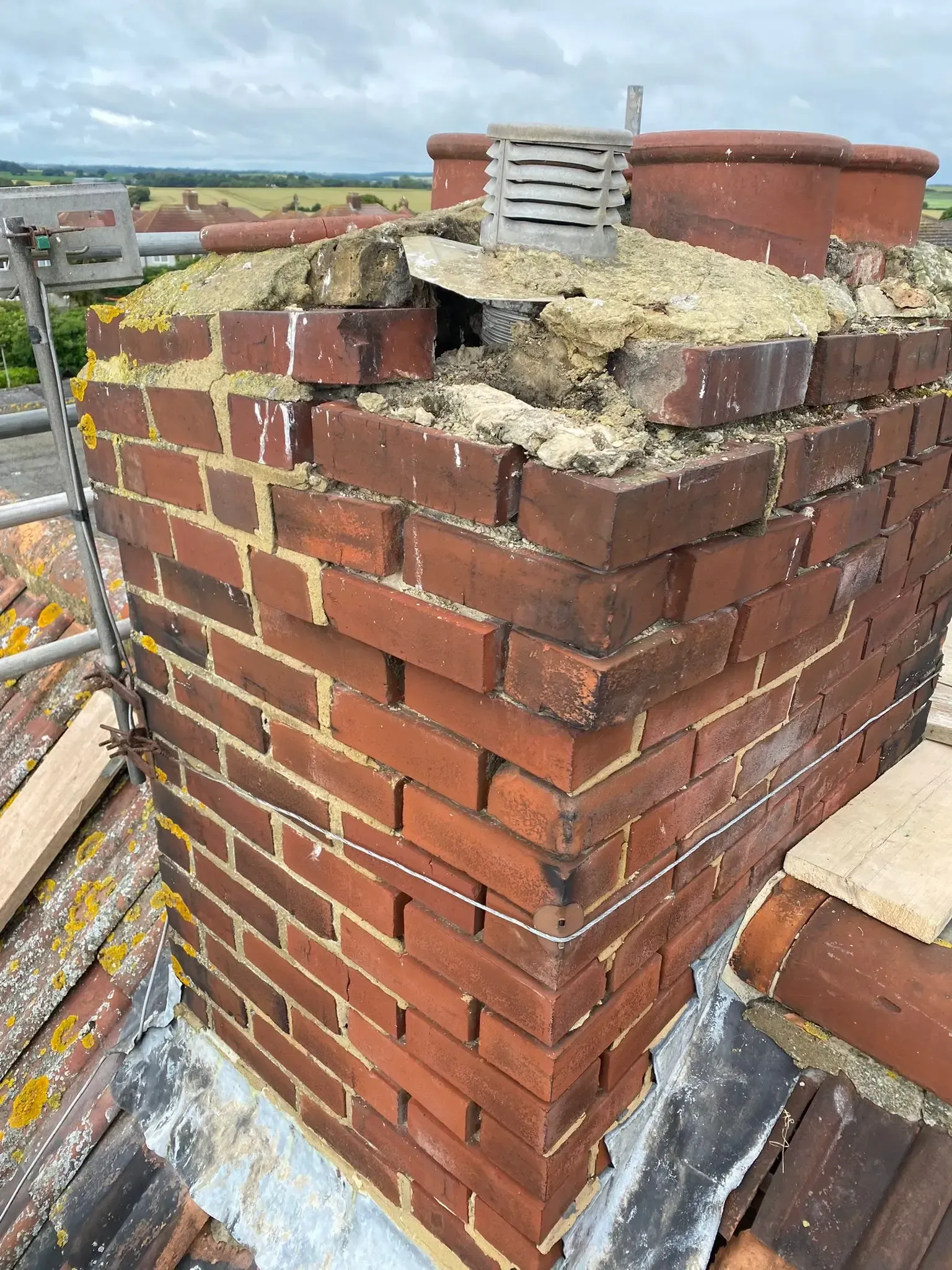
Replacing Finlock guttering is one of the most common jobs we carry out in Derby. We remove the original concrete sections and install a seamless aluminium system — lighter, watertight, and sized correctly for modern rainfall demands. The result eliminates the source of the damp problem permanently, not just the symptom.
If you have concrete gutters on a Derby property and you’ve noticed internal damp near the eaves or at the top of walls, call us for a free survey on 01332-529704.
Metal Guttering Requires Less Upkeep Than You Might Expect
One of the most common things we hear from Derby homeowners is that they’ve been replacing UPVC guttering every few years. It splits at the joints, goes brittle, or sags and pulls away from the fascia. The cycle repeats.
Metal guttering — both aluminium and zinc — breaks that cycle. Neither material rusts in the way steel does, and neither needs the routine painting that cast iron demands. Polyester powder-coated aluminium only needs a wipe-down with warm soapy water to maintain its finish. An annual leaf-clear in autumn is the main maintenance task for most Derby properties.
That said, Derby’s tree coverage does create a real debris problem. Properties near Allestree Park, the Derwent Valley riverside, or heavily wooded streets in Mickleover see gutters fill up with leaf matter fast. This is true regardless of material. We recommend a gutter-clear each autumn before the heaviest rain arrives.
What routine maintenance looks like:
- Annual clear of leaves and debris, particularly October–November
- Check bracket fixings haven’t loosened over winter
- Inspect joints and downpipe connections after any severe weather
- Wipe down powder-coated surfaces once or twice a year with mild soapy water
We offer maintenance visits as a standalone service. If you’re on a rental property or managing multiple units in Derby, ask about a repeat-visit arrangement.
Choosing the Right Gutter Profile Protects Your Fascias and Foundations
Gutter problems in Derby rarely start with the gutter itself. They start with the wrong profile for the roof catchment area, incorrect fall angle, or downpipes that can’t move water away fast enough. The result is overflow — and overflow is where the damage starts.
Water pouring down an exterior wall in Derby saturates brickwork. Derby sits on heavy clay soil, and saturated ground near a building causes the clay to expand and contract. That movement puts pressure on foundations and can worsen subsidence risk over time. The gutter is the first line of defence — but only if it’s sized correctly.
The key decisions in profile selection:
- Catchment area — larger roof areas need a deeper or wider gutter channel
- Roof pitch — steeper pitches throw water off faster, requiring higher-capacity profiles
- Downpipe positions — too few outlets create standing water in the gutter run
- Profile style — OG (ogee) suits traditional Derby terraces; half-round suits period and heritage properties; deep-flow box section suits commercial properties and large roof areas
- Downpipe size — 63mm, 76mm, or 100mm diameter options depending on water volume
We measure all of these during our free roof-edge survey. We don’t quote from photos or rough dimensions — we come out to your Derby property, take accurate measurements, and recommend the right profile for your specific roof.
A Correct Gutter Installation Starts With a Proper Roof-Edge Survey
A poor gutter installation is often invisible until the rain arrives. Brackets fitted too far apart allow the gutter to sag and pool. Wrong fall angle means water sits stagnant and spills at joints. A downpipe connected without a proper seal allows water to track back behind the fascia.
Many Derby properties have had extensions added over the decades without anyone updating the gutter layout to match. A rear extension on a property in Chellaston or Alvaston can double the roof catchment area draining into the original gutter run — which was never sized for that volume.
Our pre-installation survey covers:
- Fascia board condition — we won’t fit to rotten timber
- Existing bracket spacing and fixings
- Correct fall angle (minimum 1:600 gradient toward the downpipe)
- Downpipe positions and connection to surface drainage or soakaway
- Profile sizing based on measured catchment area and roof pitch
- Checking for thermal expansion gaps on longer aluminium runs
- Compatibility check if your property has existing copper flashings or fittings
The survey is free and comes with no obligation. After the survey, we give you a written quote with materials, labour, and timescales clearly set out. No hidden extras.
Failing Gutters in Derby Need Prompt Action Before Winter
Autumn is when gutter faults become urgent in Derby. A blocked or sagging run that’s been dripping through summer turns into a problem the moment heavy rain arrives in October. Ice forming in a cracked joint over winter can split the section entirely.
Properties in Mickleover and Allestree tend to have above-average tree coverage. Leaf build-up in half-round profiles is common, and even well-maintained gutters can overflow if a bird nest or debris dam forms at the downpipe inlet.
Common signs your guttering needs attention — don’t ignore these:
- Water dripping behind the fascia board during rain
- Visible sagging or pulling away from the wall
- Green or black staining on brickwork below the gutter line
- Overflow from the middle of a gutter run (not just the downpipe)
- Joints that have pulled apart or lost their seal
- Damp patches appearing on internal walls near the eaves
- Mould growth in the loft — often linked to leaking concrete gutters
We offer same-week inspection across Derby. We’ll confirm on-site whether a repair will hold or whether replacement is the right call — and we’ll give you a straight answer.
Finlock Removal, Seamless Aluminium and Zinc: What’s In and Out of Scope
- Free roof-edge survey measuring catchment area, roof pitch, fascia condition, bracket spacing and fall angle
- Supply and fit of seamless aluminium guttering, extruded on-site in one continuous run up to 30 metres
- Supply and fit of zinc guttering in half-round or ogee profile for period and heritage properties
- Removal of old concrete (Finlock) guttering and replacement with a seamless aluminium system
- Choice of gutter profile — OG (ogee), half-round, or deep-flow box section — matched to your roof
- Downpipes supplied in 63mm, 76mm or 100mm diameter, sized to the water volume involved
- Fascia and bracket condition check before any guttering is fitted, so nothing is hung on rotten timber
- Advice on suitable profiles and finishes for properties in Derby’s conservation areas
- Written quote setting out materials, labour and timescales before work starts
Not Included / Costed Separately
- Replacement of rotten fascia or soffit boards themselves — if the survey finds rot, this is priced as a separate item
- Roof covering repairs, such as tile or slate work, which is quoted under our separate roofing services
- Ongoing annual gutter clearing after installation, unless you take up a standalone maintenance visit arrangement
- Additional expansion joint provision on runs over 40 metres, priced according to the length involved
- Any council pre-application enquiry fee, where a conservation area or listed status check throws one up
From Finlock Strip-Out to a Sealed Aluminium or Zinc Run
Here is what happens on your Derby property from first call to a finished, weathertight run.
- Book a free survey: Call or use the contact form to arrange a free, no-obligation roof-edge survey — no quote is given over the phone from a description alone.
- On-site assessment: We measure catchment area, roof pitch, fascia condition, bracket spacing and fall angle, and check for existing copper flashings or fittings that need to be compatible with the new system.
- Written quote: You get a written quote covering materials, labour, profile choice and timescale, with no hidden extras added later.
- Removal of old guttering: Failed UPVC or concrete (Finlock) sections are stripped back, checking the fascia underneath before anything new goes up.
- Installation: Aluminium is extruded into a seamless run directly from our vehicle to match your roofline; zinc is fitted in half-round or ogee profile at the correct fall angle for clean drainage.
- Completion check: We check bracket fixings, joints and downpipe connections before leaving, and can arrange a standalone maintenance visit ahead of autumn leaf-fall if you want one.
Aluminium vs Zinc: Where the Cost Difference Actually Comes From
Aluminium costs more to fit than UPVC, and zinc costs more again than aluminium — but that ranking reverses once you look at the whole life of the property. UPVC tends to be replaced several times over a building’s life, while a correctly installed aluminium system runs for decades and zinc for many decades beyond that, so the higher price at fitting is offset by not paying for repeat replacement every few years. Seamless aluminium, formed on-site in one continuous run rather than sectional lengths, generally costs a little more than a sectional system because of the reduced risk of joint failure it’s designed to remove. What you actually pay depends on the profile you choose (OG, half-round or deep-flow box section), the catchment area and pitch of your roof, how many downpipes are needed, and whether old Finlock guttering or fascia repairs have to be dealt with first — so we don’t put a fixed figure on a job without seeing the property. Every enquiry starts with the free roof-edge survey, and you get a written quote with materials, labour and timescales set out afterwards, based on your actual roof rather than an estimate from a photo.
Aluminium, Zinc or UPVC — How the Three Guttering Options Compare
| UPVC | Aluminium | Zinc | |
|---|---|---|---|
| Typical lifespan | Often replaced every few years on exposed Derby properties | 20–50 years; some BBA-certified systems guaranteed to a 30-year minimum | Many decades; premium systems rated by manufacturers to well over 100 years |
| Upfront cost | Lowest | Mid-range | Highest |
| Ongoing maintenance | Frequent joint and seam repairs | Occasional wipe-down; annual leaf-clear | No painting, ever; self-healing patina; annual leaf-clear |
| Behaviour in frost and heat | Brittle in cold, warps and sags in heat | Holds its shape in both extremes | Holds its shape in both extremes |
| Jointing | Sectional, multiple joints per run | Can be formed seamless on-site, up to 30 metres with no mid-run joints | Fitted in half-round or ogee profile lengths |
| Best suited to | Budget-driven, short-term fixes | Terraced, semi-detached and most Derby homes | Period properties, conservation areas, commercial and rental portfolios wanting a fit-once system |
Twenty Years Untangling Derby’s Finlock Problem, With the Access Kit to Match
A gutter that’s sagging or running over on a Derby roofline is rarely just an eyesore — water finding the wrong side of a fascia board for a few winters works into the brickwork and timber underneath, and that’s a far more expensive repair than the guttering itself would have been. Getting the fall angle, bracket spacing and jointing right first time matters more here than on most home improvement jobs, and it’s the same job whether that roofline is a Georgian or Victorian terrace on Church Street or Old Lane in Darley Abbey’s conservation area, where profile and material choice also has to respect the area’s listed mill village character, or a straightforward semi on the edge of the city. Reaching those roof edges safely, particularly on three-storey terraces, commercial units and properties with restricted ground-level access, needs the right equipment rather than an extension ladder propped against a gable end. Our team holds IPAF certification for powered access and MEWP operation, and PASMA certification for mobile access tower work, so the platform used matches the property instead of the job being improvised around whatever’s on the van. That sits alongside over 20 years working on Derbyshire roofs, a free roof-edge survey on every job rather than a quote from a photo, and a written quote with materials, labour and timescales set out before work starts.
Derby and Darley Abbey: Matching Aluminium or Zinc to the Street
Derby is where most of our guttering work happens, from Victorian terraces close to the city centre out to newer estates on its edges, with jobs further out reaching across Derbyshire as a matter of course. Darley Abbey sits inside that core area and is a conservation area in its own right, built up around the old mill village, with listed mill buildings and Georgian and Victorian terraces along streets such as Church Street and Old Lane. Guttering on those properties is usually zinc, fitted in a half-round or ogee profile rather than aluminium or UPVC, to keep the roofline in keeping with the area’s protected character, and that’s factored into the survey and profile advice given on every Darley Abbey quote. Outside Darley Abbey we fit both aluminium and zinc systems across Derby’s other suburbs and out into Derbyshire’s surrounding towns and villages, with the free roof-edge survey available wherever the property is.
Areas We Cover for Aluminium & Zinc Guttering in Derby
Derby Roofers proudly serves homeowners and businesses throughout Derby city and the wider Derbyshire area for seamless aluminium and zinc guttering, including Finlock concrete gutter removal. Not sure if we cover your area? Call us on 01332-529704 and we’ll be happy to help.
- Derby City Centre (DE1)
- Allestree, Mackworth & Quarndon (DE22)
- Mickleover (DE3)
- Littleover & Normanton (DE23)
- Chaddesden, Oakwood & Spondon (DE21)
- Alvaston, Crewton & Osmaston (DE24)
- Belper (DE56)
- Ripley (DE5)
- Ilkeston (DE7)
- Heanor (DE75)
- Swadlincote (DE11)
- Ashbourne (DE6)
- Matlock (DE4)
- Borrowash & Draycott (DE72)
- Etwall & Hilton (DE65)
- Melbourne & Chellaston (DE73)
- Duffield & Little Eaton (DE56 / DE21)
- Breadsall & Darley Abbey (DE21 / DE22)
- Long Eaton (NG10)
- Castle Donington (DE74)
Frequently Asked Questions About Aluminium & Zinc Guttering in Derby
Is aluminium guttering better than UPVC for Derby homes?
Yes — aluminium is the more durable choice for most Derby properties. It resists frost, doesn’t crack under impact, and outlasts UPVC by a significant margin. UPVC costs less upfront but tends to need replacing more frequently, particularly on terraced properties exposed to temperature swings and debris from nearby trees. Over the full lifespan of a property, aluminium typically costs less overall.
How long does aluminium guttering last?
A correctly installed aluminium guttering system has a functional life expectancy of around 20–50 years, depending on the grade of aluminium used and the quality of installation. Seamless systems with fewer joints tend to outperform sectional ones. Some manufacturer-certified systems carry a BBA (British Board of Agrément) certificate confirming a minimum 30-year life expectancy.
How long do zinc gutters last?
Zinc gutters are among the longest-lasting rainwater systems available. Under good conditions, properly installed zinc guttering can last many decades — premium zinc systems are often rated to well over 50 years by manufacturers. The natural patina that forms on the surface protects the metal without any additional coating.
What are the main disadvantages of aluminium guttering?
The main drawback is a higher upfront cost than UPVC. Aluminium can also dent if struck by a heavy object — though it won’t crack or leak as a result, unlike plastic. Correct bracket spacing during installation prevents sagging. On runs over 40 metres, expansion joints should be included to allow for thermal movement.
What is the longest-lasting gutter material?
Zinc and copper are the longest-lasting options, with potential lifespans measured in decades rather than years. Aluminium is the next best choice — and by far the most widely fitted metal guttering on Derby residential properties. Cast iron can also last a very long time but requires regular painting to prevent rust.
Do aluminium or zinc gutters need repainting?
No. Aluminium guttering is powder-coated during manufacture — that finish doesn’t require touching up under normal conditions, just an occasional wipe-down. Zinc develops its own natural patina and never requires painting. This makes both materials well suited to properties where access for future maintenance is limited.
What is seamless aluminium guttering and is it better?
Seamless aluminium guttering is formed on-site in one continuous length using a specialist rolling machine. Because there are no mid-run joints, it dramatically reduces the risk of leaks. It’s a better option than sectional guttering for most properties, particularly on longer elevations typical of Derby’s terraced streets.
Can aluminium guttering replace my old concrete (Finlock) gutters?
Yes — and it’s one of the most effective solutions for this problem. We remove the original concrete sections and install a seamless aluminium system in their place. This stops the damp, eliminates the thermal bridging that concrete gutters cause, and gives you a modern, low-maintenance rainwater system.
What is Finlock guttering and why does it fail?
Finlock is a concrete guttering system cast into the roof edge of many mid-20th-century Derby properties, rather than fitted as a separate gutter. Its concrete cracks and the integral asphalt lining perishes with age, letting water track into the fascia and wall below long before the leak is visible from ground level. Once that lining has gone, patching the crack doesn’t stop the underlying seep, so the practical fix is stripping it out and fitting a seamless aluminium or zinc system in its place.
Should I choose aluminium or zinc for my property?
Aluminium, formed as a seamless run with no mid-run joints, suits most terraced, semi-detached and modern Derby homes and typically lasts 20 to 50 years, with some systems guaranteed to a 30-year minimum. Zinc costs more to fit but can run for many decades longer, develops a self-healing patina rather than needing paint, and is the more appropriate choice on period properties or in conservation areas such as Darley Abbey, where a half-round or ogee profile is expected. We advise on which suits your roofline at the free survey rather than defaulting to one option.
How long does a guttering replacement take?
Most single-property jobs — removing old Finlock or UPVC and fitting the new aluminium or zinc run — are completed within a day once the quote is agreed, though larger commercial runs or properties needing fascia repairs first take longer. The written quote sets out the timescale for your specific job before work starts.
What happens if the fascia underneath is rotten?
We check fascia and bracket condition as part of the survey before fitting anything new. If rot is found, it isn’t hidden behind the new guttering — replacing the fascia or soffit board is priced as a separate item, so you know about it before work starts rather than discovering it later.
Do you fit guttering on listed or conservation area properties?
Yes. Darley Abbey’s conservation area, built up around the old mill village, generally calls for zinc in a half-round or ogee profile to keep the roofline in keeping with its Georgian and Victorian terraces, and that’s factored into the survey and profile advice on every quote for properties on streets such as Church Street and Old Lane.
How do you access upper floors and awkward roof edges safely?
Our team holds IPAF certification for powered access and MEWP operation and PASMA certification for mobile access tower work, so the platform used is matched to the property rather than improvised with an extension ladder — relevant on three-storey terraces, commercial units and properties with restricted ground-level access.
Do you offer ongoing gutter maintenance after installation?
Not as standard — clearing after installation is a separate, standalone maintenance visit arrangement rather than something bundled into the installation price. We can arrange one ahead of autumn leaf-fall if you want to keep a new system running clear.
What sizes of downpipe do you fit?
Downpipes are supplied in 63mm, 76mm or 100mm diameter, sized to the catchment area and water volume calculated at survey rather than fitted as a default size regardless of roof.
Do you provide a written quote before starting work?
Yes, every job gets a written quote setting out materials, labour, profile choice and timescale after the free survey, so there’s nothing added once work is underway.
Stop a Failing Finlock Run Before It Reaches the Brickwork
A cracked Finlock gutter or a sagging aluminium joint doesn’t fix itself, and every season it’s left is another round of water finding its way into the fascia and wall below.
Book the free roof-edge survey and get a written quote for a seamless aluminium or zinc replacement before autumn rain puts the roofline to the test. Derby Roofers has been carrying out guttering and Finlock removal work across Derby and Derbyshire for over 20 years.
- ✅ Free roof-edge survey and written, no-obligation quote
- ✅ Seamless aluminium runs formed on-site up to 30 metres
- ✅ IPAF & PASMA-certified access team
- ✅ Zinc and Finlock removal specialists
Call or email us to arrange a free roof-edge survey, with no obligation to book anything in.